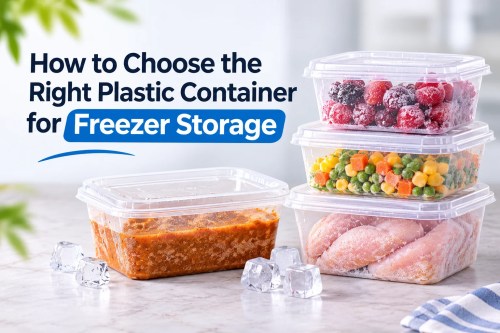
Freezing food is one of the most practical ways to reduce waste, preserve ingredients, and prepare meals in advance. Whether you are storing homemade curries, frozen vegetables, meat, sauces, or ready-to-eat meals, choosing the right storage container plays an important role in maintaining food quality.
However, not every plastic container is designed to withstand freezing temperatures. Some containers become brittle, develop cracks, or fail to seal properly when exposed to extreme cold. Using unsuitable packaging can result in freezer burn, food leakage, and unnecessary waste.
Understanding how to choose the right plastic containers for freezer storage helps households, restaurants, cloud kitchens, and food businesses keep their ingredients organized and protected.
What Are Freezer-Safe Plastic Containers?
Freezer-safe plastic containers are food storage containers specifically designed or approved by their manufacturers for use at freezing temperatures, commonly around -18°C (0°F) in household and commercial freezers.
These containers are made from materials and designs that can tolerate low temperatures without cracking, deforming, or losing their ability to seal under normal intended use.
A suitable freezer storage container should offer:
-
Food-contact suitability for the intended food
-
Manufacturer-confirmed freezer compatibility
-
A secure and properly fitting lid
-
Sufficient durability at low temperatures
-
Appropriate capacity for the food being stored
-
Convenient stacking and organization
It is important to understand that food-grade and freezer-safe are not interchangeable terms. A container may be suitable for direct food contact without being designed for freezing.
Why Choosing the Right Plastic Container Matters
The quality of your freezer storage containers can affect food freshness, storage efficiency, and the amount of food wasted.
1. Helps Prevent Freezer Burn
Freezer burn occurs when frozen food loses moisture and becomes dehydrated, often because of exposure to air or inadequate packaging.
Although freezer-burned food is not automatically unsafe, it may develop dry patches, unpleasant textures, and reduced flavor.
Using a container with a secure lid and minimal unnecessary airspace can help reduce these problems.
2. Reduces the Risk of Cracking
Some plastics become more brittle at low temperatures. Containers not intended for freezing may crack when dropped, squeezed, or handled roughly.
Choosing a product specifically rated for freezer use reduces the likelihood of damage during normal storage and handling.
3. Makes Food Storage More Organized
Stackable containers allow households and commercial kitchens to use freezer space efficiently.
Separate containers for meat, vegetables, sauces, and prepared meals also make inventory management easier.
4. Helps Reduce Food Waste
Appropriate portion sizes allow users to freeze only what they need and thaw manageable quantities.
This is particularly useful for restaurants, meal preparation businesses, and households that prepare food in bulk.
How to Choose the Best Plastic Containers for Freezer Storage
Selecting a suitable container involves more than checking its size or appearance. The material, lid design, shape, and intended storage duration all influence performance.
1. Check Whether the Container Is Freezer-Safe
The first step is to confirm that the container is approved for freezer use.
Look for a freezer-safe label, a manufacturer’s stated temperature range, or product documentation confirming suitability for low-temperature food storage.
A snowflake symbol may indicate freezer compatibility, but symbols vary between manufacturers. Always check the accompanying instructions.
Avoid assuming that a container is freezer-safe simply because it is thick or described as food-grade.
2. Understand the Different Plastic Materials
Plastic food containers are manufactured from different polymers, each with its own properties.
Polypropylene (PP)
Polypropylene is commonly used in food storage containers because it is lightweight and offers good chemical resistance.
Some PP containers are suitable for freezing, while others may become brittle under particular conditions. Check the manufacturer’s freezer-use specifications rather than relying on the PP material code alone.
High-Density Polyethylene (HDPE)
HDPE is used in various food storage products and is valued for its toughness and moisture resistance.
Freezer-rated HDPE containers can be suitable for storing ingredients, sauces, and prepared foods.
Polyethylene Terephthalate (PET)
PET is widely used for transparent food packaging, including cold food and beverage containers.
However, ordinary PET takeaway containers should not automatically be considered suitable for freezer storage. The specific product must be rated for the intended temperature.
Low-Density Polyethylene (LDPE)
LDPE is frequently used in flexible food packaging, including certain freezer bags.
Freezer-grade LDPE bags can be useful for vegetables, meat portions, and other foods that do not require rigid protection.
The key consideration is the finished product’s freezer rating, not simply its recycling number.
3. Choose Containers With Secure, Airtight Lids
An effective lid helps reduce moisture loss, odor transfer, and accidental spills.
When comparing airtight plastic containers, look for lids that fit evenly and remain secure during normal handling.
Common closure designs include snap-on lids, locking lids, and screw-top lids.
For liquids and semi-liquid foods, a properly designed leak-resistant seal is especially important. However, an airtight claim does not necessarily mean a container is leakproof when tilted or transported.
Before purchasing containers in bulk, test a sample with the intended food and storage conditions.
4. Select the Right Container Size
Container capacity should match the amount of food being stored.
Oversized containers create unnecessary airspace, while overfilled containers can place pressure on the lid when liquids expand during freezing.
Consider the following practical uses:
-
250ml containers: Small sauce portions, chutneys, purees, and individual ingredients.
-
500ml containers: Single portions of curry, soup, vegetables, and prepared meals.
-
750ml containers: Medium meal portions, marinated ingredients, and leftovers.
-
1000ml containers: Larger meal portions and family-sized ingredients.
-
1500ml or larger containers: Bulk ingredients, provided the container is freezer-rated and the food can freeze efficiently.
These sizes are illustrative rather than universal recommendations. The best capacity depends on the food’s volume, consistency, and portion requirements.
For fruits and vegetables, smaller packages generally freeze more quickly and help preserve quality. University of Minnesota Extension recommends packages of no more than approximately half a gallon for home freezing.
5. Consider the Shape and Design
Container shape affects freezer organization and ease of use.
Rectangular and square containers generally make efficient use of shelf space because they can be arranged closely together.
Round containers may be convenient for soups, sauces, and foods that need stirring.
Wide-mouth containers make frozen contents easier to remove, particularly when food has not fully thawed.
For restaurants and commercial kitchens, uniform container shapes can simplify stacking, labeling, and inventory management.
6. Check Durability at Low Temperatures
Freezer storage can expose containers to physical stress, particularly when they are stacked, moved, or dropped.
Look for products designed to maintain their structural integrity at the intended freezing temperature.
A suitable container should not crack under normal use, and its lid should remain functional after freezing.
Containers that develop cracks, distorted rims, or damaged closures should be replaced.
7. Consider Reusability and Cleaning
Reusable plastic containers can be economical for households and businesses that store food regularly.
However, not every disposable food container is intended for repeated use.
If you plan to reuse a container, verify that the manufacturer permits it and follow the recommended cleaning instructions.
Inspect reusable containers regularly for scratches, staining, cracks, and damaged seals.
For commercial food operations, cleaning and reuse procedures should also follow applicable food hygiene requirements.
Best Plastic Containers for Different Types of Frozen Food
Different foods require different packaging approaches. Matching the container to the food helps protect quality and improve storage efficiency.
Frozen Meat and Poultry
Raw meat and poultry should be packaged to minimize air exposure and prevent leakage.
Freezer-rated rigid containers can be useful for marinated meat, chicken portions, and prepared kebabs.
For irregularly shaped cuts, freezer-grade bags or wrapping may provide a closer fit and reduce unused airspace.
Store raw meat separately from ready-to-eat foods to reduce cross-contamination risks.
Soups, Curries, and Sauces
Liquid and semi-liquid foods are generally well suited to rigid freezer-safe containers.
Choose containers with tight-fitting lids and leave sufficient space for expansion during freezing.
For Pakistani households, this approach works well for foods such as chicken curry, daal, nihari, and homemade gravies.
Cool cooked food safely before freezing. Divide large batches into shallow portions and refrigerate promptly rather than leaving them at room temperature for extended periods.
Frozen Vegetables
Vegetables benefit from smaller, appropriately sized freezer containers that limit air exposure.
Some vegetables require blanching before freezing to help preserve color, texture, and flavor.
Use clearly labeled containers and avoid repeatedly opening the same package to remove small portions.
Rice and Prepared Meals
Cooked rice, pasta, and prepared meals can be frozen in portion-sized containers.
Shallow rectangular containers are convenient for stacking and allow food to cool and freeze more efficiently.
Cooked rice requires particular attention to time and temperature control. Refrigerate or freeze it promptly after cooking, and avoid leaving it at room temperature for long periods.
Fruits and Purees
Freezer-safe containers can also be used for fruit purees, smoothie ingredients, and prepared fruit portions.
For liquid purees, leave appropriate headspace for expansion.
For sliced fruit, use smaller portions and reduce unnecessary air exposure.
How to Prevent Freezer Burn in Plastic Containers
Freezer burn is one of the most common quality problems associated with frozen food.
It develops when moisture is lost from the food’s surface, often resulting in dry patches, changes in color, and reduced flavor.
According to the National Center for Home Food Preservation, suitable freezer packaging should resist moisture and vapor transfer, seal effectively, and withstand freezing temperatures.
To reduce freezer burn:
-
Use containers specifically designed for freezing.
-
Select a size that minimizes unnecessary airspace.
-
Ensure lids are fitted securely.
-
Use appropriate freezer-grade wrapping for foods requiring additional protection.
-
Keep the freezer at approximately -18°C (0°F) or below.
-
Avoid frequent temperature fluctuations.
-
Label food with its freezing date and use older stock first.
Remember that freezer burn primarily affects food quality. It does not automatically mean the food is unsafe, although food that was mishandled before freezing may still present a safety risk.
Common Mistakes to Avoid When Buying Freezer Storage Containers
Even a well-designed storage system can perform poorly when unsuitable containers are used.
Using Ordinary Takeaway Containers Without Checking Their Rating
Many takeaway containers are designed primarily for short-term food packaging.
Some can tolerate freezing, but others may crack or fail to seal correctly.
Always verify freezer compatibility before using them for long-term storage.
Filling Containers to the Top
Liquids expand when frozen.
Overfilling soup, gravy, or sauce containers may cause lids to lift or containers to crack.
Leave sufficient headspace according to the container manufacturer’s instructions.
Choosing Containers With Loose Lids
Poorly fitting lids allow air and moisture to move more freely, reducing frozen food quality.
Inspect lids before freezing and avoid using damaged containers.
Freezing Large Quantities in One Container
Large food portions may take longer to freeze and can be inconvenient to thaw.
Smaller portions support easier meal planning and reduce the need to thaw more food than required.
Ignoring Labels and Storage Dates
Unlabeled containers can make it difficult to identify food or determine how long it has been stored.
Use freezer-resistant labels showing the food name, preparation date, and quantity.
How Restaurants and Cloud Kitchens Can Choose Freezer Storage Containers
Restaurants, catering businesses, and cloud kitchens often need to freeze ingredients in larger quantities than households.
For these businesses, packaging selection should consider daily production, freezer capacity, food safety procedures, and operating costs.
Match Container Sizes to Daily Production
A cloud kitchen preparing 100 meals daily may benefit from standardized ingredient portions.
For example, sauces can be divided into smaller batches rather than stored in one large container.
This makes it easier to retrieve the required quantity without repeatedly opening or thawing larger portions.
Standardize Containers Across the Kitchen
Using a limited range of compatible container sizes can simplify inventory management.
Uniform containers also make stacking and labeling easier.
However, stackability should be confirmed with the supplier, especially when containers are filled.
Calculate the Cost Per Use
The cheapest container is not necessarily the most economical option.
Consider purchase price, durability, reuse permissions, lid replacement costs, and food waste caused by packaging failures.
A slightly more expensive container may provide better value when it is suitable for repeated freezer use.
Test Before Buying in Bulk
Before purchasing a large quantity, request product specifications or samples.
Test the containers with the foods you intend to store.
Check lid fit, stacking stability, performance after freezing, and any signs of cracking.
For commercial buyers, confirming the supplier’s product specifications is particularly important.
Plastic Containers vs Freezer Bags: Which Is Better?
Both rigid plastic containers and freezer bags can protect frozen food when they are designed for freezer use.
Plastic containers are particularly useful for soups, curries, sauces, prepared meals, and delicate foods that need protection from crushing. They are easy to stack, label, and organize.
Freezer bags work well for meat portions, chopped vegetables, and irregularly shaped ingredients. They can also save space because excess air can be pressed out before sealing.
For businesses handling both liquids and solid ingredients, a combination of rigid containers and freezer-grade bags may be the most practical solution.
What to Check Before Buying Freezer-Safe Plastic Containers in Pakistan
When purchasing food storage containers in Pakistan, consider the following factors:
-
Confirm that the manufacturer specifies freezer compatibility.
-
Check whether the material is suitable for food contact.
-
Choose container sizes according to household or commercial needs.
-
Inspect lid quality and sealing performance.
-
Verify whether the product is disposable or reusable.
-
Ask about bulk quantities if purchasing for a restaurant.
-
Compare the overall cost rather than focusing only on the unit price.
For businesses in Karachi, purchasing packaging supplies in suitable quantities can help maintain consistent kitchen operations and reduce unnecessary stock shortages.
Frequently Asked Questions
1. Which plastic container is best for freezer storage?
The best option is a food-grade container specifically rated for freezer use, with a secure lid and suitable capacity. Freezer-rated rigid plastic containers are particularly useful for sauces, curries, soups, and prepared meals.
2. Can all plastic food containers be used in the freezer?
No. Some plastic containers are designed only for refrigerated or room-temperature storage. Always check the manufacturer’s freezer-use instructions before freezing food.
3. Is polypropylene (PP) plastic safe for freezer storage?
Some polypropylene containers are suitable for freezing, but not all PP products are designed for low temperatures. Freezer compatibility depends on the specific container’s formulation, construction, and manufacturer specifications.
4. Can you freeze curry in plastic containers?
Yes, provided the container is food-grade and freezer-safe. Cool the curry safely, transfer it into appropriate portions, leave space for expansion, and secure the lid before freezing.
5. Are airtight containers better for freezing food?
Airtight containers help limit air exposure and moisture loss, which can reduce freezer burn. However, the container must also be designed for freezing temperatures.
6. Can freezer-safe plastic containers go in the microwave?
Not necessarily. Freezer-safe and microwave-safe are separate product specifications. Only microwave food in containers specifically approved for that purpose.
7. What size plastic container is best for freezing meals?
For individual meals, containers around 500ml to 1000ml may be practical, depending on the portion. Smaller containers can be useful for sauces, while larger sizes may suit family meals.
8. How do you prevent plastic containers from cracking in the freezer?
Use freezer-rated containers, avoid overfilling liquids, handle frozen containers carefully, and replace any products showing cracks or damaged lids.
9. Can disposable plastic containers be reused for freezing?
Only if the manufacturer permits reuse and freezer storage. Single-use containers should not automatically be treated as reusable freezer storage products.
10. How long can food stay in freezer-safe plastic containers?
Storage duration depends on the food, packaging quality, and freezer temperature. Food continuously stored at -18°C (0°F) or below can remain safe for extended periods, but its quality gradually declines. Follow food-specific storage recommendations.
Conclusion
Choosing the right plastic container for freezer storage is essential for maintaining food quality, organizing ingredients, and reducing unnecessary waste.
The most important factors are freezer compatibility, food-grade materials, secure lids, appropriate sizes, and durability at low temperatures.
For households, properly selected containers make meal preparation and food storage more convenient. For restaurants and cloud kitchens, they can also improve portion management, inventory organization, and operational efficiency.